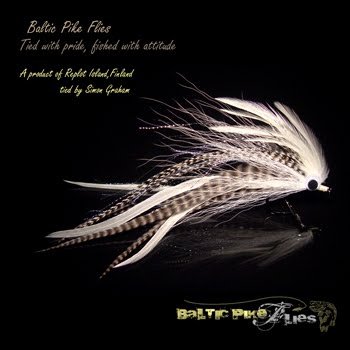
Started with tying on red raccoon zonker then several white & grizzly microbarb saddles. Then palmered on some Black UV polar chenille. added an already painted white popper head. stuck a couple of elongated eyes on the opposite way around and then bug bonded it reverse side round.
Then palmered on another piece of Black UV polar chenille for its nose....jobs a good en! I don't make the raccoon zonker tail so long with these flies as I would with say my raccoon bunnies purely because I want the fly to stay elevated and a long section would make the fly very unbalanced. I can see there is going to be a lot of development with this kinda fly over the winter. Tying them onto tubes is the obvious step forward.
Fishing shallow water has made me reassess how I target pike on the fly. I like to vary the way I retrieve a fly during the course of a session between fast medium and slow. With so many rock here and the amount of times one can get snagged up I'm tying more and more flies that stay well elavated in the water column yet work just below the surface. Poppers aren't that effective here on the Baltic sea probably because we don't have any frogs in the saline water and majority of the smaller rodents like mice and water voles generally stay close to fresh water ditches, ponds etc etc. So I've started using a lot more sliders than ever before.
This Olive raccoon slider has been tied onto a Fulling mill 6/0 long shank hook. I 1st started with a 100mm length or olive raccoon zonker tied half way down the hook. added several white and grizzly microbarb saddles. Then palmered on some olive UV polar chenille. The added the slider head which is a trimmed foam popper head reversed. Painted black then bug-bonded over the the whole surface area. Then finished of the nose with some more olive UV polar chenille. I love this chenille. It just adds some extra sparkle to the front of the fly as well as provide a slight bit of resistance when retrieving the fly. I must admit I've really enjoyed the last couple of wading sessions I've been out, purely because I haven't had to worry about my fly getting snagged.
Although a great fish to catch and am chuffed for the fella, I feel his fish handlling skills are much to desired. This boat needs a net and not a gaff. It's unclear whether fish was killed or returned but after having a gaff stuffed through its gills and being slammened on the floor a couple of times I would gather this fish sank to the bottom and died......we'll never know.
This is the 3rd predator in the set I tied in Green & Chartreuse colouration. I'm not as happy with the construction of this fly as I am with the other two. It started off ok but I ended up packing the middle clumps of Chartreuse bucktail after the initial collar to tightly up against the ball of yellow flash chenille,which resulted in it becoming to elavated for my liking.
The front green collar I tied on last could have been much shorter n length. It looks absolutely amazing under the water.....I can't argue that,its just a bit of a bugger to cast than the others. What I like with these predators is the extra movement the microbarb saddles and rubber legs give to the fly.
Getting back to the question of Spey casting for pike, Dan Mcguire uploaded another video yesterday with regards to the set up he uses to cast all manner of different flies and especially how easy it is to cast them considerable distance. Since I started using this method I've found its not the distance I'm battling with,but finding a fly that will stay elevated long enough before it starts dragging on the bottom. Even with a slow sink intermediate on, once I've cast it 90 to 100ft, with all the rocks here around the island, I'm getting snagged up more times than not.
I have some decent bridges to fish under (Replot bridge being one of them), that have some depth under them but on a whole I'm fishing generally in depths of around a meter to two meters. My Rattle n Hums seem to be okay but I'm going to have to go back to the drawing board as I've found the wire with the beads on..... that act as a counter weight and keeps the hook point up turned........ hinders casting slightly. What I do know is that its going to have to incorporate some form of bendback style fly or at least a fly I dont have to use a weed guard with.
Many purests say that adding spinnerblades to your fly changes it more into a lure than a fly. I personally don't find anything wrong with the concept. Whether its a spinner blade,or a rubber jigging worm added to the hook or even a plastic diving lip......if I can cast it with a fly rod then its a fly in my eyes. This looks more like a trawlng fly due to the size of the blade and I would expect it works better with a small spinning rod but it has given me food for thought to maybe add tiny spinning blades to some of my flies.
I mean I've been known to add tiny propellor blades to the front of my flies.....so why not spinner blades. It would be interesting to hear what others think about adding attractors to a fly like propellors or spinner blades!


 Started with tying on red raccoon zonker then several white & grizzly microbarb saddles. Then palmered on some Black UV polar chenille. added an already painted white popper head. stuck a couple of elongated eyes on the opposite way around and then bug bonded it reverse side round.
 Then palmered on another piece of Black UV polar chenille for its nose....jobs a good en! I don't make the raccoon zonker tail so long with these flies as I would with say my raccoon bunnies purely because I want the fly to stay elevated and a long section would make the fly very unbalanced. I can see there is going to be a lot of development with this kinda fly over the winter. Tying them onto tubes is the obvious step forward.